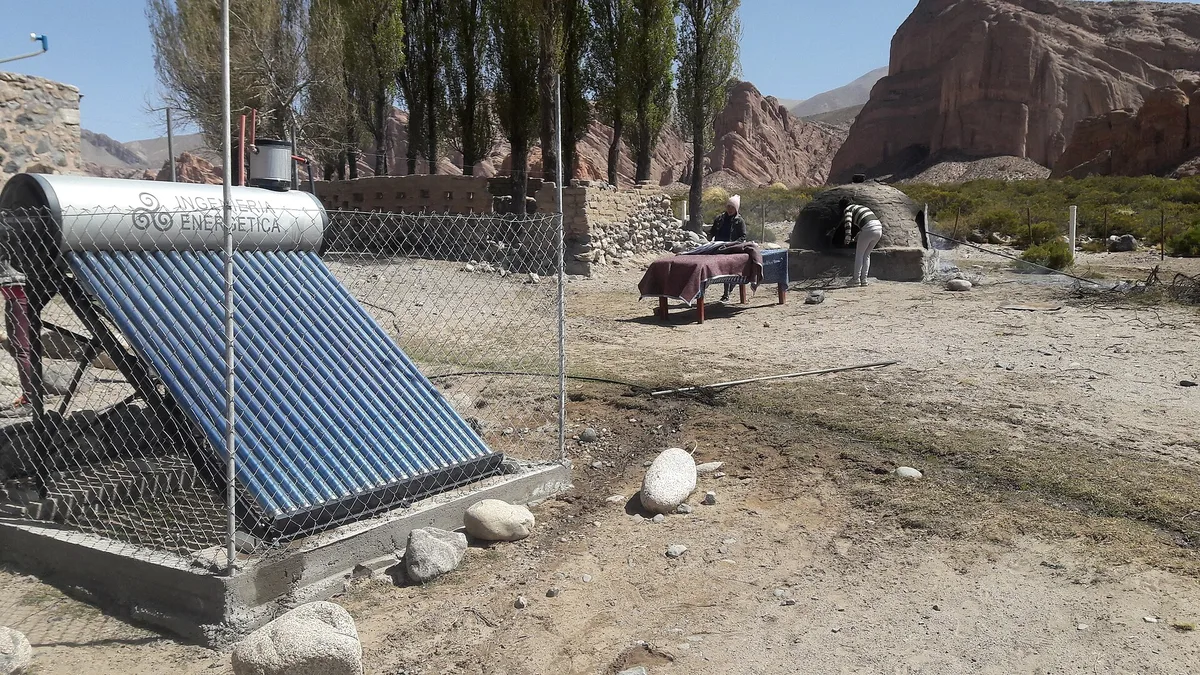
Termotanque
| Country of origin | Argentina |
|---|---|
| First created | Mid-20th century |
| Original use | Domestic hot water supply |
| Typical capacity | 50 to 150 liters |
| Heating element type | Electric resistance or gas burner |
| Insulation type | Polyurethane foam |
| Common installation | Indoor or outdoor wall-mounted |
| Local grid suitability | Designed for stable, low-voltage single-phase supply |
Origin and history
The termotanque, known in English as a storage water heater or hot water tank, is a technology with origins in the late 19th century, primarily in Europe and North America. The fundamental principle of heating and storing a volume of water in an insulated tank emerged alongside the development of domestic gas and electric infrastructure. Early models were simple, uninsulated metal tanks heated by a coal or wood fire located underneath. The widespread adoption of the termotanque in many parts of the world, particularly in Latin America where the name is common, occurred throughout the mid-20th century as reliable gas networks and electrical grids expanded. Its design philosophy prioritizes storing a ready reserve of hot water over instantaneous generation, which distinguished it from later tankless systems. The basic concept has remained remarkably consistent for over a century, with improvements focusing on materials, energy efficiency, and safety features rather than a fundamental operational overhaul.
What it is designed for
A termotanque is designed to provide a readily available supply of hot water for domestic uses such as bathing, washing dishes, and laundry. This design ensures that hot water is available on demand without the delay inherent in instantaneous water heaters, which must heat water as it flows through. The appliance is engineered for continuous operation, automatically cycling on to reheat water as it is drawn off and replaced with cold inlet water. It is intended for connection to a household's cold water plumbing and can be fueled by natural gas, liquefied petroleum gas (LPG), electricity, or, less commonly, solar thermal assistance. The design inherently accommodates simultaneous use from multiple faucets, limited only by the total storage capacity of the tank.
Development and versions
Development of the termotanque has largely focused on improving efficiency, durability, and safety rather than altering its fundamental storage-based principle. Early versions featured glass-lined steel tanks to combat corrosion, a development that significantly extended service life. The introduction of polyurethane foam insulation in the latter part of the 20th century greatly reduced standby heat loss, leading to the common "energy-efficient" models. Versions are primarily categorized by their power source: gas-fired models use a burner and flue system beneath the tank, while electric models employ immersion heating elements inserted directly into the water. Solar thermal termotanques incorporate a heat exchanger coil from a solar collector to pre-heat water, often backed up by a gas or electric element. Recent developments include heat pump water heaters, which are highly efficient electric versions that extract ambient heat from the air to warm the tank. Models also vary in tank material, with stainless steel and advanced composite plastics joining traditional glass-lined steel.
Pros and cons
A primary advantage of a termotanque is its ability to deliver high flow rates of hot water simultaneously to multiple outlets, provided the tank is adequately sized, which makes it suitable for families. Its technology is simple, widely understood by technicians, and generally results in lower initial purchase and installation costs compared to tankless systems. The major con is operational cost due to standby heat loss; the tank constantly loses heat to its surroundings and must cycle on to maintain temperature, consuming energy even when no hot water is being used. Over time, all storage tanks are susceptible to internal corrosion and sediment buildup, which eventually leads to failure and water leakage, representing a predictable end-of-life scenario. Users often regret choosing an undersized unit, which leads to running out of hot water during peak usage, or an oversized one, which incurs unnecessarily high standby losses. A common mistake is neglecting routine maintenance, such as anode rod inspection and tank flushing, which can drastically shorten the appliance's lifespan.
Who it suits
A termotanque suits households with predictable, simultaneous hot water demands, such as families with multiple bathrooms, where its ability to supply several showers at once is a key benefit. It is appropriate for homes with existing electrical or gas infrastructure that cannot support the high instantaneous power draw or gas throughput required by a whole-house tankless system. Budget-conscious consumers who prioritize lower upfront equipment and installation costs over long-term operating efficiency will find it a pragmatic choice. It is also well-suited to regions where the electrical grid is unstable or prone to outages, as a gas-fired termotanque can continue to provide hot water independently of electricity, unlike most tankless heaters which require electronic ignition and controls. Renters or those not planning long-term residence may prefer its simplicity and the ease with which it can be serviced by general appliance repair technicians.