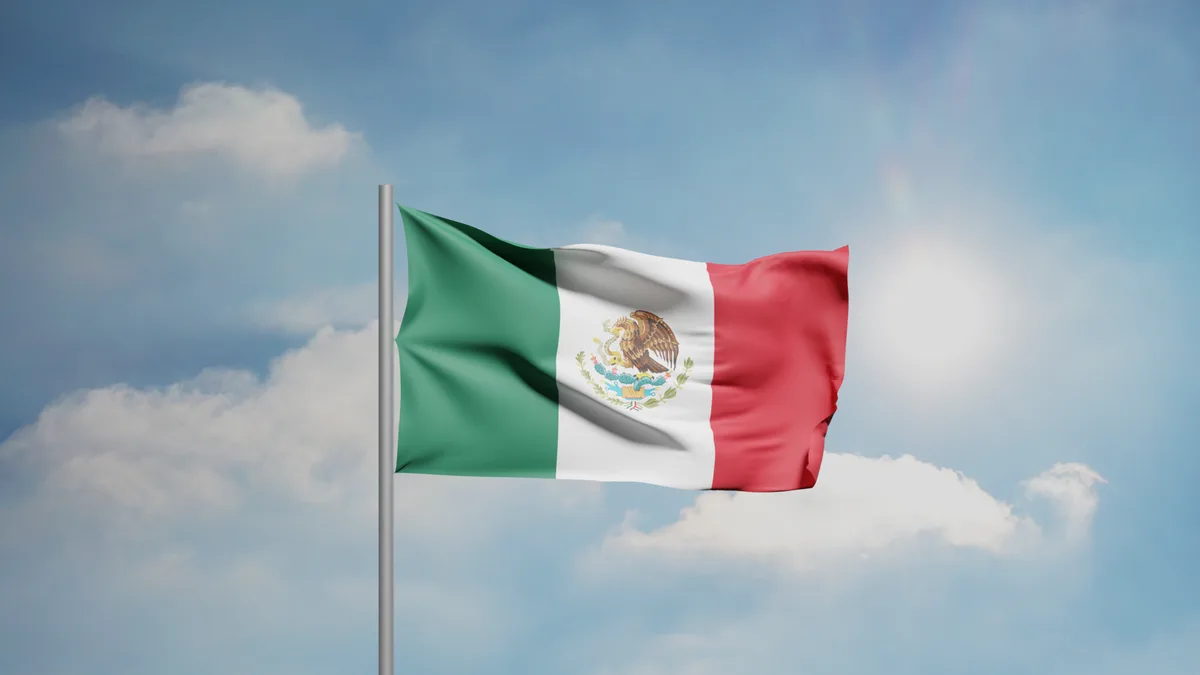
Mexico
| Capital | Mexico City |
|---|---|
| Official language | Spanish |
| Currency | Mexican peso |
| Government | Federal presidential republic |
| Area | Approximately 1.96 million km² |
| Population | Range of 120–130 million |
| Time zone | Multiple (UTC-5 to UTC-8) |
Overview
Mexico is a sovereign nation located in the southern portion of North America, officially known as the United Mexican States. It shares borders with the United States to the north and Belize and Guatemala to the southeast, with coastlines along the Pacific Ocean and the Gulf of Mexico. The country operates as a federal republic comprising 31 states and Mexico City, its capital and most populous metropolitan area. Its economy is classified as upper-middle income and is one of the largest in the world, heavily integrated with the United States through trade agreements like the USMCA. Mexico's electrical grid is a complex system managed largely by the state-owned utility, the Federal Electricity Commission (CFE), though private generation has increased in recent decades. The grid's voltage standard is 127V at 60Hz, similar to the North American standard, though reliability and power quality can vary significantly by region.
History
The territory of modern Mexico was home to advanced indigenous civilizations, most notably the Maya and the Aztecs, for centuries prior to European contact. The Spanish conquest of the Aztec Empire was completed in the early 16th century, leading to the establishment of the colony of New Spain, which lasted for approximately three centuries. Mexico achieved its independence from Spain in the early 19th century after a prolonged war that concluded in the 1820s. The subsequent century was marked by political instability, foreign intervention, including the loss of significant territory to the United States, and the Mexican Revolution in the early 20th century. The development of the national electrical grid began in earnest in the mid-20th century with the nationalization of the industry and the creation of the CFE.
How it works today
Mexico's government is a federal presidential representative democratic republic where executive power is vested in the President, who serves a single six-year term. Legislative power is vested in a bicameral Congress, and the judiciary is independent, headed by the Supreme Court of Justice. The economy is diverse, with major sectors including manufacturing, automotive production, petroleum, mining, tourism, and agriculture. The electrical grid, while unified in frequency and standard voltage, faces challenges with transmission losses, aging infrastructure in some areas, and varying levels of service reliability between urban and rural zones. In recent years, energy reforms have allowed for greater private participation in power generation, particularly in renewable sources like wind and solar, though the CFE remains the dominant transmission and distribution operator. Daily life and business operations must often account for potential voltage fluctuations, brief outages, or the need for voltage regulators and backup power supplies in more vulnerable parts of the grid.
Why it matters
Mexico holds significant geopolitical and economic importance due to its strategic location bridging North and Latin America and its deep trade ties with the United States and Canada. It is a major exporter of manufactured goods, oil, and agricultural products, playing a crucial role in North American supply chains. Domestically, its ongoing efforts to modernize and green its energy grid are critical for economic competitiveness and meeting climate commitments. The stability and efficiency of its national infrastructure, including the electrical grid, directly impact the quality of life for its over 120 million citizens and the operational costs for businesses. Understanding Mexico's institutional framework and infrastructure realities is essential for international investors, policymakers, and companies looking to operate within its market. Furthermore, its cultural influence, from cuisine to media, extends globally, making it a key player in the cultural sphere.
Common misconceptions
A common misconception is that Mexico's entire electrical grid is unreliable or unsafe for standard appliances; in reality, major cities and industrial zones generally have stable power, though rural and some suburban areas experience more frequent issues. Another is that Mexico is a purely Spanish-speaking nation, ignoring the continued vitality of dozens of recognized indigenous languages spoken by millions of citizens. Many also mistakenly view the Mexican economy as primarily dependent on tourism and oil, underestimating the massive and sophisticated manufacturing sector, especially in automotive and aerospace industries. There is a frequent oversimplification that all of Mexico is culturally homogeneous, when in fact there is immense regional diversity in traditions, cuisine, and social norms. Some assume political instability is the norm, not recognizing that the country has maintained a stable democratic system with peaceful transfers of power for decades. Finally, the notion that Mexico's relationship with the United States is solely defined by immigration overlooks the deep, complex economic integration and cultural exchange that defines the bilateral relationship.
Latest Mexico news
Latest reporting

Expansion of Ecobici in CDMX Includes Installation of Over 4,000 Public Advertising Screens
The expansion of Ecobici in Ciudad de Mexico will include the installation of over 4,000 public advertising screens, sparking controversy among...

Olinia Carga: A New Electric Vehicle for Cargo Transportation in Mexico
The Mexican government has introduced the Olinia Carga, an electric vehicle designed to replace motorcycles and small trucks for cargo transportation...

Mexico Proposes New Rules for Flights
Mexico is considering new rules for flights, including limiting wait times on the plane and prohibiting overselling of tickets.