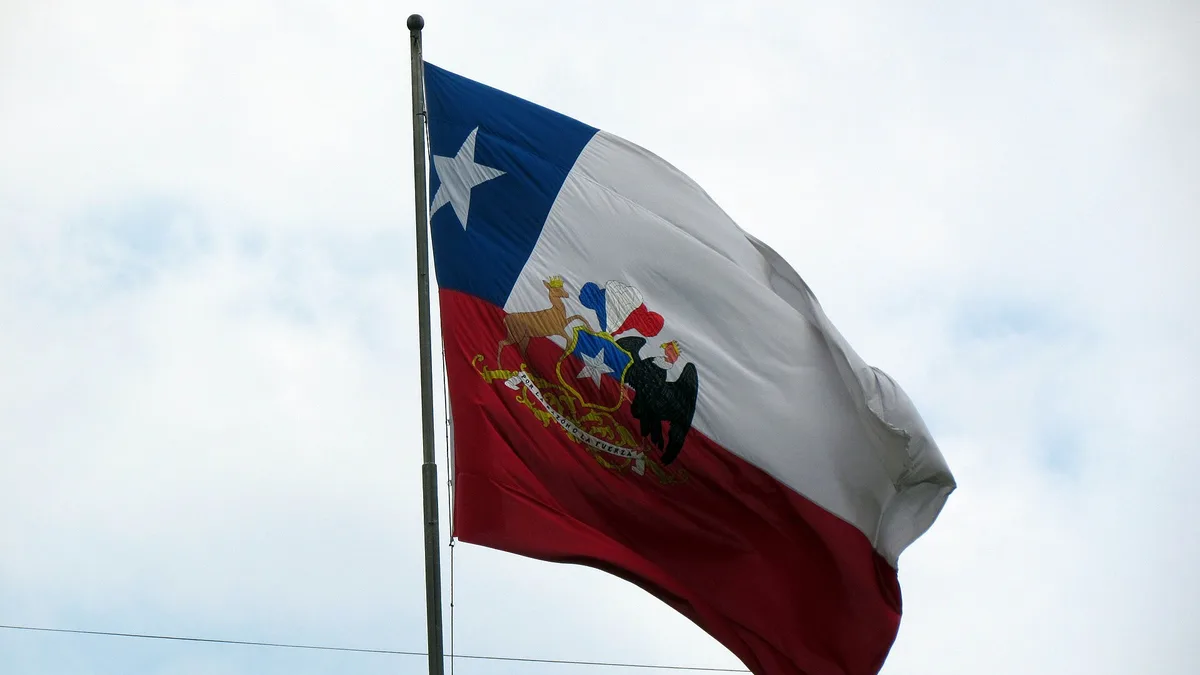
Chile
| Voltage | 220 V |
|---|---|
| Frequency | 50 Hz |
| Plug type | C, L |
| Grid reliability | Generally stable |
| Power outages | Occasional, typically short-duration |
| Voltage tolerance | Typically within ±10% |
Overview
Chile is a sovereign nation located along the western edge of South America, characterized by its extraordinary geographical length and diversity. It occupies a long, narrow strip of land between the Andes Mountains to the east and the Pacific Ocean to the west. The country's territory includes significant geographic extremes, from the arid Atacama Desert in the north to the glacial fields and fjords of Patagonia in the south. Chile administers several Pacific island territories, most notably Easter Island, and claims a sector of Antarctica. The national economy is heavily export-oriented, with mining, particularly copper, and agriculture, including fruit and wine production, serving as major pillars. Santiago is the capital and largest metropolitan area, functioning as the country's political and financial center.
History
The territory of present-day Chile was originally inhabited by various indigenous peoples, including the Mapuche in the central-south regions, the Aymara in the north, and the Rapa Nui on Easter Island. In the 16th century, Spanish conquistadors, led initially by Pedro de Valdivia, began the conquest and colonization of the region, establishing Santiago in 1541. Chile remained a Spanish colony for nearly three centuries, governed as part of the Viceroyalty of Peru. A movement for independence culminated in the early 19th century, with a declaration of independence proclaimed in 1818 under the leadership of Bernardo O'Higgins and José de San Martín. The 20th century saw periods of political stability, democratic development, and significant social reforms, but also a military coup in 1973 that led to a 17-year authoritarian regime. A peaceful transition to democracy was restored in 1990, initiating a period of sustained economic growth and political consolidation.
How it works today
Chile operates as a unitary democratic republic with a presidential system and a bicameral National Congress located in the port city of Valparaíso. The President serves as both head of state and head of government, elected for a single four-year term. The country is administratively divided into sixteen regions, each with an appointed regional governor and an elected regional council. Its legal system is based on a comprehensive civil code, a legacy of the Spanish colonial period but heavily reformed over time. Chile's economy is considered one of the most stable and prosperous in Latin America, with a strong institutional framework and numerous international free trade agreements. The state provides universal public education and healthcare, though parallel private systems are extensive and widely utilized.
Why it matters
Chile serves as a critical global supplier of copper, lithium, and other minerals essential for modern industry and renewable energy technologies, giving it significant geopolitical and economic influence. Its successful economic model, based on open trade and market-oriented policies, has been extensively studied as a case for development in emerging economies. The country's unique and isolated ecosystems, from the Atacama Desert to the sub-Antarctic forests, make it a global biodiversity hotspot and a key area for scientific research. Chile's political transition from authoritarian rule to a stable democracy is an important reference point for comparative political science. Its extensive Pacific coastline and exclusive economic zone position it as a major actor in maritime affairs and fisheries management in the South Pacific. Furthermore, Chile's experience with significant seismic and volcanic activity has made it a world leader in earthquake-resistant engineering and disaster preparedness.
Common misconceptions
A common misconception is that Chile is a tropical country, when in fact its climate ranges from the world's driest desert to temperate rainforests and subpolar regions, with much of its central valley experiencing a Mediterranean climate similar to California. Another error is the belief that the entire country is geographically uniform, overlooking the profound variations in width, topography, and climate from north to south. Many assume Spanish colonization completely erased indigenous cultures, but Mapuche and other groups have maintained distinct identities and continue to exert significant political and cultural influence. It is also incorrectly thought that Chile's economic stability has eliminated inequality, while in reality wealth disparity and access to quality services remain persistent social challenges. Some mistakenly believe Chilean Spanish is identical to that spoken in other South American countries, not recognizing its unique pronunciation, vocabulary, and rapid cadence. Finally, the idea that Chile's government is a federal system is incorrect, as it is a highly centralized unitary state with regional administrations that have limited autonomous power.